Card use now accounts for roughly two-thirds of consumer payments in the U.S., while cash sits at around one in seven, according to the Federal Reserve's 2026 Diary of Consumer Payment Choice. That shift matters for any agency or business still relying on manual cash handling.
Many government offices and utilities accept payments daily without understanding what's happening behind the scenes — authorization, clearing, settlement. That gap can lead to poor vendor choices or security blind spots. This guide breaks down exactly how a transaction moves from swipe or tap to settled funds.
Key Takeaways
- Payments move data and funds between customer, merchant, and banks through gateways and processors
- Four core stages: authorization, capture, clearing, and settlement
- Parties involved: cardholder, merchant, acquirer, issuer, card networks, gateway, and processor
- PCI-DSS and EMV certification are non-negotiable for secure processing
- Government agencies and utilities can automate the full flow with self-service payment kiosks
What Is Payment Transaction Processing?
Payment transaction processing is the system of steps and technologies that authenticate, transfer, and record funds electronically between a payer and a payee. The process runs as a coordinated sequence across multiple financial institutions and technical intermediaries.
Manual cash and check handling is slow, error-prone, and limited to staffed business hours. Electronic processing solves that operational gap by working continuously, without a human at a counter.
Important distinction: a payment gateway and a point-of-sale terminal are components of this system, not the whole thing. The gateway captures and encrypts data. The terminal reads the card. Processing is everything that happens in between and after.
Digital wallets, ACH transfers, and kiosk payments still rely on the same underlying authorization-clearing-settlement chain. Types commonly supported include:
- Credit and debit cards
- ACH/bank transfers
- E-checks
- Digital wallets (Apple Pay, Google Pay)
- Cash-accepting kiosks
The mechanics stay largely consistent across all of them.
How Does Payment Transaction Processing Work?
Whether a payment is swiped, tapped, or entered at a self-service kiosk, it follows the same defined sequence: initiation, authorization, clearing, and settlement.

Initiation
The process begins the moment a payer presents credentials — at a point-of-sale terminal, a website checkout, or a kiosk screen. Initiation can be:
- Manual — an in-person card swipe or tap
- Automated — kiosk-based bill pay or recurring billing setups
Common bottlenecks show up here first. Poor internet connectivity or an incompatible card reader can stall a transaction before it even reaches a bank.
Authorization & Data Transmission
Once initiated, encrypted payment data travels through a gateway to a processor. The processor then reaches both banks in the path:
- Acquiring bank — the merchant's or agency's bank
- Issuing bank — the cardholder's bank, which checks available funds or credit and returns an approval or decline
Visa describes this processor role as powering real-time authorization — online, not a delayed batch. Actual speed still depends on the terminal, gateway, network, and issuer. There is no universal two-second rule; track your own median response times instead of assuming a fixed number.
Clearing and Fraud/Compliance Checks
This is the control stage. The system verifies transaction details, screens for fraud signals, and confirms the transaction complies with card network rules before funds actually move.
Key mechanisms at play:
- PCI-DSS controls — the current standard is PCI DSS v4.0.1, the only active version after v4.0 retired at the end of 2024
- EMV chip validation — EMVCo Level 1 testing checks terminal communication protocols; Level 2 tests the payment application software itself
Weakening this stage invites fines, chargebacks, and fraud losses that quickly outweigh any savings on cheaper equipment.
Settlement & Output
Finally, funds move from the issuing bank, through the card network, to the acquiring bank, and into the merchant or agency's account.
Settlement timing gets misquoted often. According to Stripe's payment settlement explainer, network settlement usually takes one to three business days, with two days being common. But that's separate from merchant funding — some banks offer next-business-day funding with specific cutoff times.
This output feeds directly into reconciliation, accounting, and reporting systems. Faster, more accurate settlement means better cash flow and fewer manual bookkeeping corrections down the line.

Key Players and Components Involved
A transaction touches more parties than most people realize:
- Cardholder — the person paying
- Merchant — the business or agency receiving payment
- Acquiring bank — the merchant's bank, which receives the funds
- Issuing bank — the cardholder's bank, which approves or declines
- Card networks — Visa, Mastercard, and similar rail providers
Two terms get confused constantly: the payment gateway handles data transmission and encryption at the front end. The payment processor facilitates the actual transaction and connects banks to networks on the back end. They're distinct functions, even when bundled together commercially.

Self-service payment environments combine several of these pieces—card reader, gateway connection, processor link—into one customer-facing flow. For government and utility agencies, that stack only works when it ties cleanly into existing billing systems. KIOSK PAY STATION supports that integration layer, connecting payment acceptance to agency billing through real-time, file-based, or non-validated synchronization, plus ongoing monitoring and support.
Where Payment Processing Is Used
Payment transaction processing shows up wherever money changes hands: retail counters, e-commerce checkouts, and mobile tap-to-pay. For government and utility bill collection, the same rails increasingly run through self-service channels.
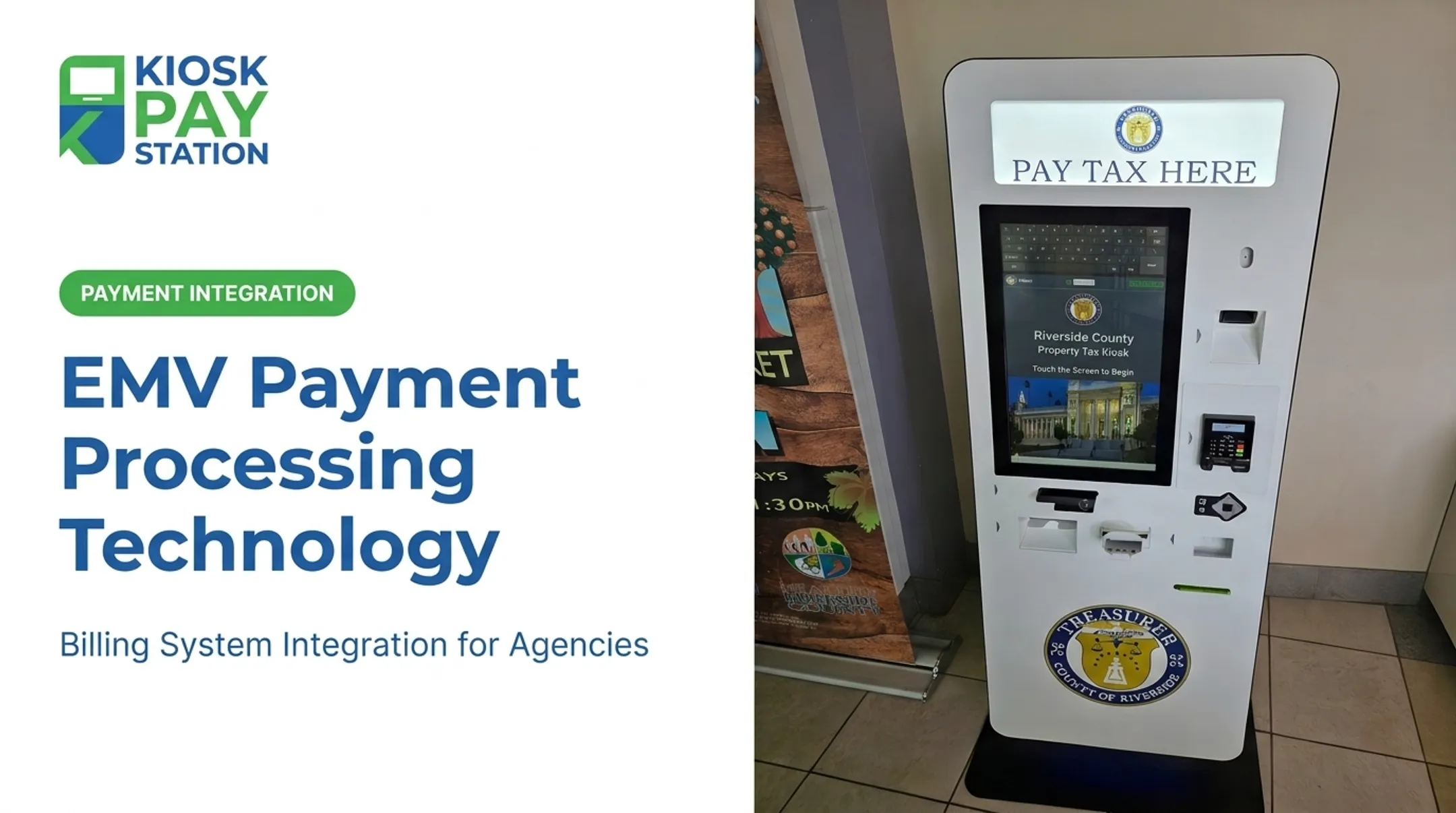
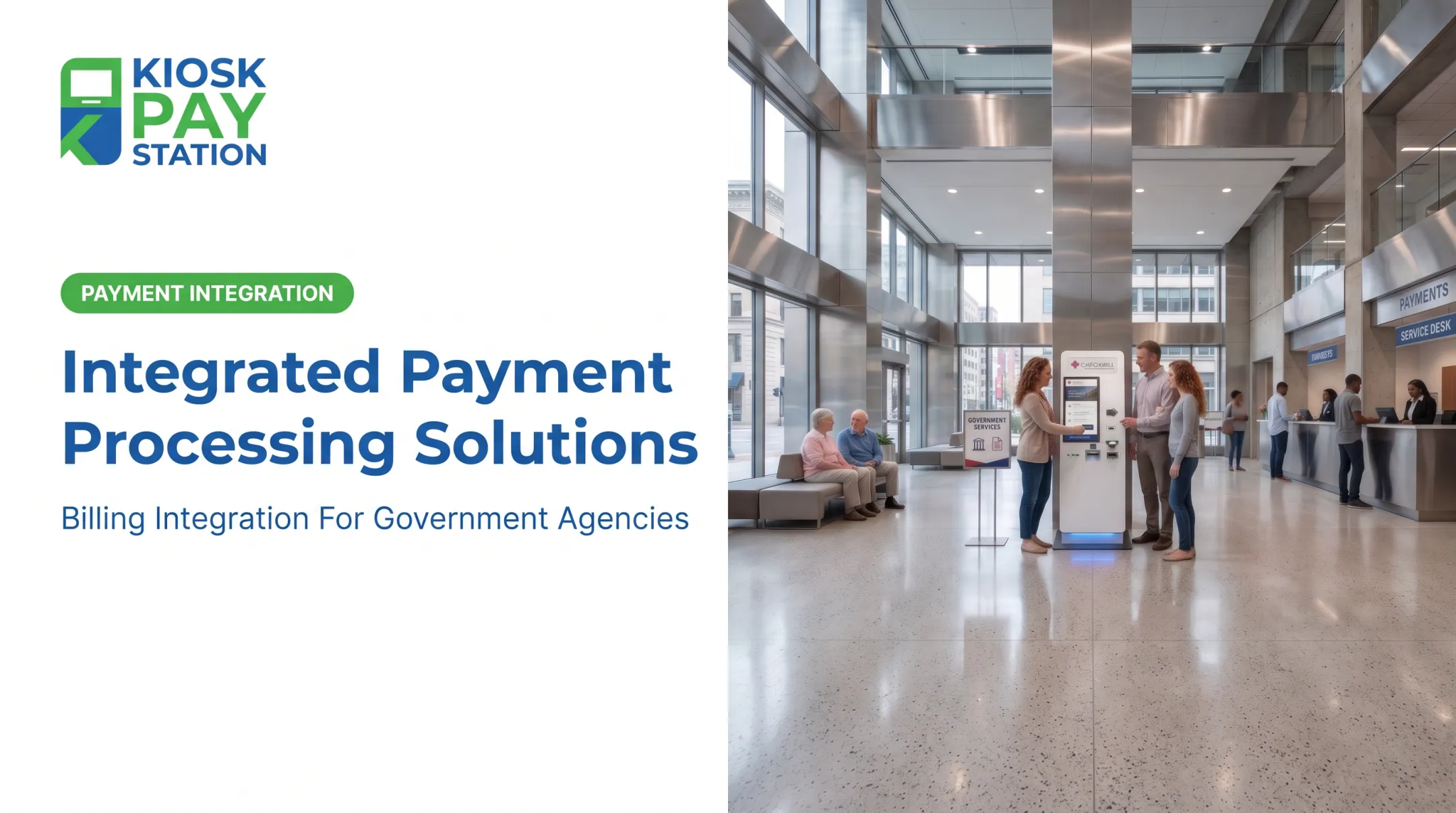
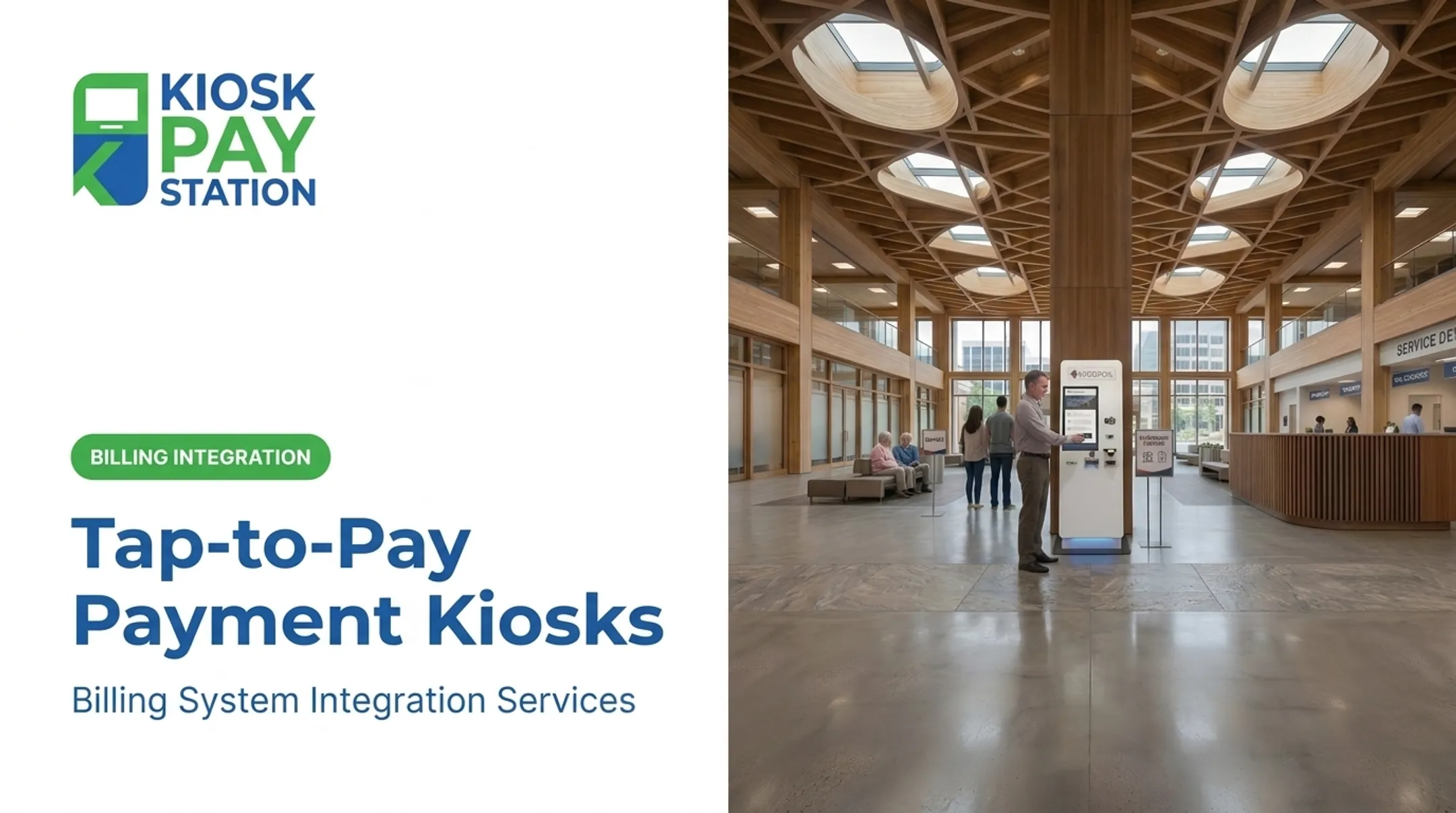
City halls, courts, utility providers, and parking authorities deploy PCI-DSS compliant, EMV-certified kiosks so residents can pay by cash, card, check, or e-wallet. That reduces reliance on a staffed counter during limited business hours.
Riverside County is a clear example. Two self-service kiosks collected $3.01 million in seven days, more than 50% of total payments in that window. Eight staffed cashier stations processed $2.4 million over the same period.

Agencies typically support payment methods in a few ways:
- Cashless setups for checks, cards, and e-wallets
- Cash-accepting units that take bills and return exact change
- Combined setups that accept every method in one place
Accessibility shapes who can complete those payments. ADA-compliant interfaces, multilingual screens, and voice-and-light guidance make self-service usable for more residents, not only the people who can wait at a counter.
In public-sector bill pay, the processing stack has to handle mixed tender, strict compliance, and clean handoff into existing billing systems. That is where design choices matter most.
Conclusion
Payment processing follows a coordinated sequence: initiation, authorization, clearing, and settlement. Banks, networks, gateways, and processors each handle a defined role in that chain. Understanding the sequence helps agencies and businesses make sharper decisions when selecting processors or payment technology.
For public agencies evaluating self-service payment options, security, compliance, and reliability have to hold together. Weakening any one of them undermines the rest.
Frequently Asked Questions
What does payment transaction processing mean?
It's the electronic system that authenticates and transfers funds between a payer and payee. This happens through gateways, processors, and banks working together in real time.
How does payment transaction processing work?
A transaction moves through four stages: initiation (payment credentials presented), authorization (issuer approves or declines), clearing (fraud and compliance checks), and settlement (funds actually move to the merchant).
What is the difference between a payment gateway and a payment processor?
The gateway transmits and encrypts payment data at the point of entry. The processor facilitates the actual movement of funds between banks and card networks. They're separate functions, even when sold as one package.
Why is PCI-DSS compliance important in payment processing?
PCI-DSS protects cardholder data across any entity that stores, processes, or transmits it. It's typically mandatory for merchants, processors, and service providers handling card transactions.
How long does it take for a transaction to settle?
Network settlement usually takes one to three business days, with two days being common. Merchant funding timelines vary by bank and can be faster or slower depending on cutoff times and agreements.
Can self-service kiosks handle full payment processing?
Yes. Self-service kiosks can run the full flow when they include EMV card acceptance, encrypted data transmission, and billing-system connections. KIOSK PAY STATION supports institutional clients with secure integration, monitoring, and support for those end-to-end bill-payment workflows.