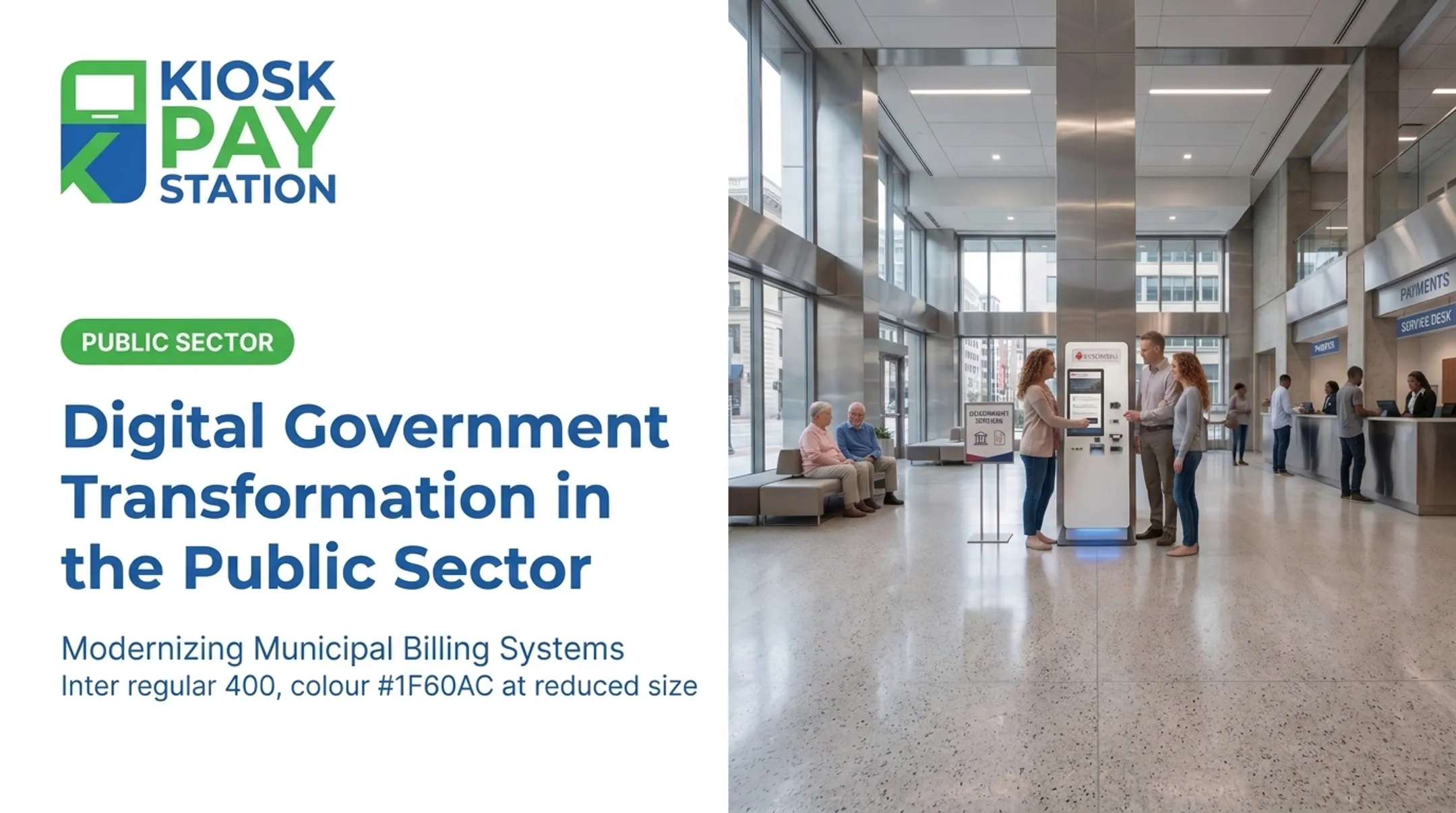
This puts real pressure on agencies. Many public-sector leaders struggle with legacy systems, tight budgets, and staff shortages while residents ask why city hall can't work like their phone. Innovation in government spans a huge range: AI policy tools, cross-agency data dashboards, and something as simple as a self-service kiosk in a lobby.
This article breaks down what public-sector innovation actually means, the four types every agency should understand, who drives it, and real examples you can adopt today.
Key Takeaways
- Public-sector innovation requires three things: novelty, implementation, and measurable impact
- Agencies typically juggle four innovation types: enhancement, mission-oriented, adaptive, and anticipatory
- Leadership and psychological safety strongly influence whether new ideas actually get tested
- Self-service payment modernization is one of the fastest, lowest-risk wins agencies can ship
What Is Innovation in the Public Sector?
The OECD's Observatory of Public Sector Innovation defines it plainly: innovation is "the process of implementing novel approaches to achieve impact." That's the whole test, and it has three parts.
- Novelty: the approach must be new to that context, not necessarily new to the world
- Implementation: it has to actually launch, not sit in a strategy deck
- Impact: it must shift public value in effectiveness, transparency, trust, or equity
Without all three, you have an idea, a pilot that never scaled, or a change with no real effect—not innovation.
Public-sector innovation doesn't follow the same rules as private-sector innovation. A private company can move fast and break things. A government agency has to balance speed with fairness, due process, and public trust. That constraint shapes how innovation gets designed and delivered.
Systemic, Social, Service, and Administrative Innovation
Researchers publishing in Public Management Review break public-sector innovation into four categories:
- Social: tackling wicked problems like homelessness or public health gaps
- Service: improving how citizens interact with government, such as GSA's 18F team modernizing the Forest Service's online permit process
- Administrative-process: redesigning internal workflows, like 18F's work building a new Tax Court case-management system
- Systemic: coordinating across organizations, such as the Federal CIO Council's interagency IT initiatives
The Four Main Types of Government Innovation
The OECD's 2019 Declaration on Public Sector Innovation, adopted by 35 member countries, identifies four distinct "facets." Agencies rarely pick just one. Most need all four running simultaneously.
- Enhancement innovation: Builds on what already exists—the most common and often least glamorous type. Austria's tax administration digitized forms and added a chatbot.
- Mission-oriented innovation: Starts with a bold goal, then maps the path. The Netherlands' Topsectoren initiative organized work around 25 national missions instead of department silos.
- Adaptive innovation: Rises from frontline staff or citizen feedback. Canada's Blueprint 2020 foresight initiative grew out of employee input beginning in 2013.
- Anticipatory innovation: Explores what is coming before it turns urgent, such as AI governance frameworks built ahead of mandates rather than in reaction to them.
Agencies need what researchers call multi-dexterity: the ability to run enhancement projects and mission-driven bets at the same time, without treating innovation as a single strategy. A tax office might modernize its payment counter (enhancement) while also piloting predictive fraud detection (anticipatory) in the same fiscal year.

What Is the Role of Government in Innovation?
Government plays two roles at once, and confusing them is a common mistake.
- Funder and enabler — grant programs, R&D funding such as SBIR/STTR (Phase I awards often in the $150,000–$323,000 range), and policy frameworks that let others build
- Direct implementer — running its own labs, pilots, and service redesigns in-house
Leadership matters more than most agencies admit. A 2024 study of Norway's Labour and Welfare Administration found transformational leadership had a strong statistical link to psychological safety (beta of .560), which in turn drove innovation climate (beta of .440).
When employees can test ideas without career risk, innovation moves. When they cannot, it stalls at the memo stage. In practice, that means leaders who:
- Protect small pilots from premature scrutiny
- Reward learning from failed tests, not only wins
- Give cross-team staff cover to challenge legacy process
U.S. agencies are building the same muscle on purpose. The Partnership for Public Service's Gov21 program trains cross-agency leaders in this kind of calculated risk-taking.
How Governments Promote and Implement Innovation
Agencies use a handful of proven mechanisms instead of starting from scratch each time.
- Innovation labs and offices: California's Office of Data and Innovation drives human-centered design across state agencies
- Cross-agency councils: the federal CIO Council coordinates multi-agency IT projects
- SBIR/STTR-style funding: connects agencies with private tech partners through structured phases
- Public challenges: prize competitions that crowdsource solutions from outside government
A typical rollout follows a pilot-test-scale sequence:
- Launch a small pilot in one department or location
- Measure results against a clear baseline
- Adjust based on real usage data
- Scale agency-wide, or county-wide, only after proof
GSA's 18F team shows what this approach delivers at scale. Over ten years, it has completed 455 projects across 34 federal agencies, plus the Executive Office of the President and the Library of Congress. Most of that work started as small pilots.

Partnerships with private vendors are standard practice. Agencies rarely build every solution in-house. Specialized vendors handle payment processing, IT infrastructure, and similar systems so internal teams can focus on policy and service design.
Real-World Examples and Project Ideas for Government Innovation
Some of the highest-impact projects are also the least complicated to launch.
Digitizing Routine Citizen Transactions
Online portals, mobile apps, and e-signatures eliminate in-person visits for things that never needed a counter visit in the first place: renewing a permit, paying a fine, or submitting a form. GSA's own digital signature policy and NYC's Department of Finance kiosk rollout both point the same direction: reduce friction, reduce lines.
Self-Service Payment Modernization
Payment counters are one of the clearest bottlenecks in local government. Long lines, limited hours, and cash-handling overhead all add up. Self-service payment options solve this directly.
Riverside County's experience is a strong proof point. Two kiosks collected over $3 million in payments during a seven-day span, outperforming eight staffed cashier stations that processed $2.4 million over the same period. More than half of all payments came through the two machines.

Agencies modernizing bill collection typically need PCI-DSS compliant, EMV-certified processing built for tax offices, courts, utilities, and parking authorities. Capabilities that matter include:
- Support for cash, check, credit/debit, and e-wallet payments
- Real-time, file-based, or non-validated integration with existing billing systems
- Custom transaction fields for department codes, account numbers, and property IDs
- Multiple lookup methods: invoice number, QR code, barcode, or account number
- Multilingual, ADA-accessible interfaces
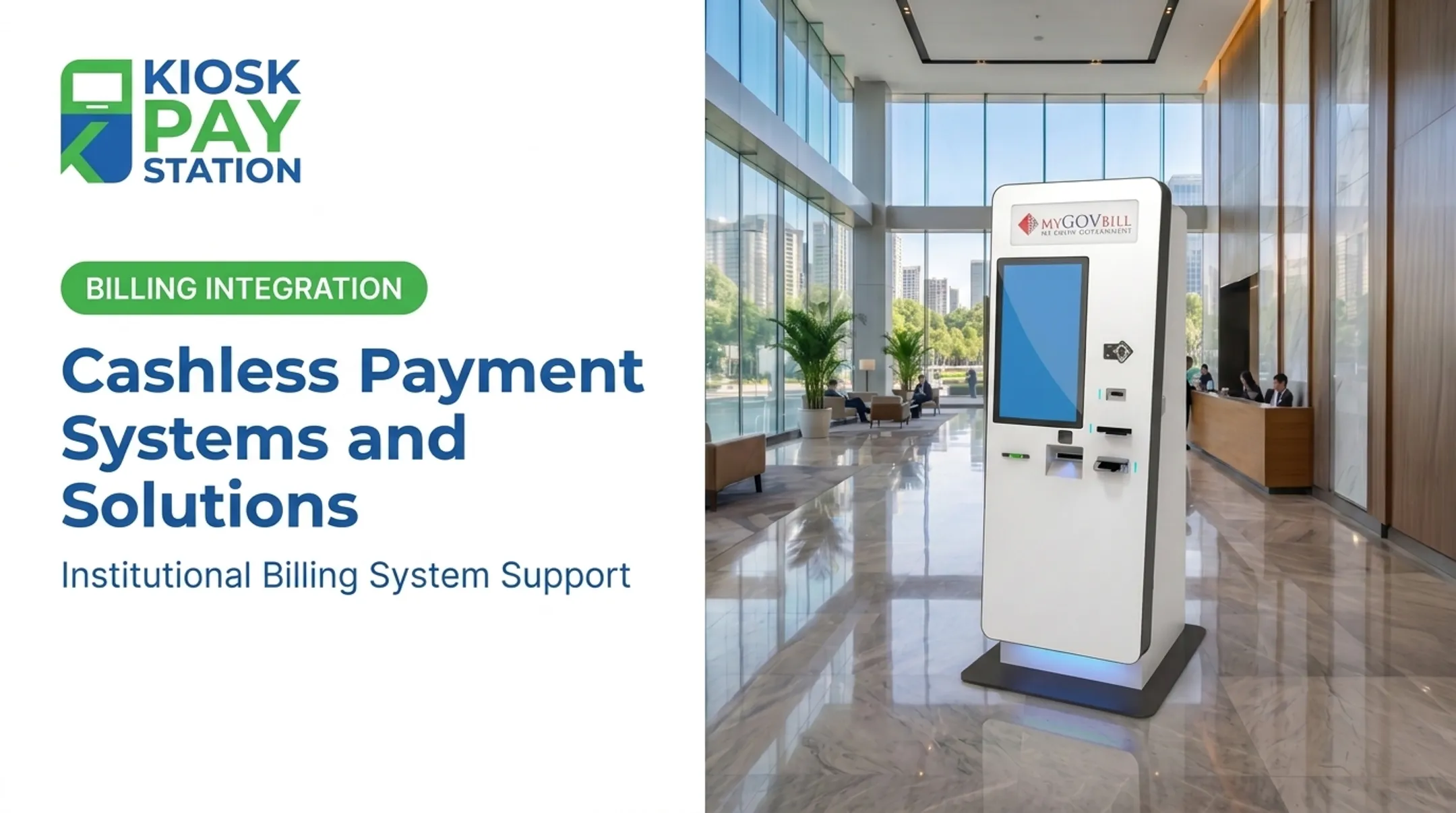
KIOSK PAY STATION supports government and utility clients with billing-system integration, monitoring, and ongoing support so payment workflows stay compliant and reconciled without adding counter staff.
Data-Driven Decision-Making
Analytics dashboards give budget offices real-time visibility instead of quarterly guesswork. The federal IT Dashboard, tracking roughly 800 major IT investments across 27 agencies, is a large-scale version of what any county finance office can do at smaller scale with its own spending and performance data.

Behavioral Insights Projects
Small wording changes in notices produce outsized results. The Office of Evaluation Sciences found that redesigned IRS outreach letters to tax preparers generated an estimated $129 million in savings during the 2021 filing season, and a related client-outreach letter campaign saved roughly $15.2 million by reducing improper payments. Neither project required new software; just better-designed mail.
Frequently Asked Questions
What is innovation in the public sector?
It's the introduction of new, implemented, and impactful ideas, policies, or technologies that improve how government delivers services. All three elements — novelty, implementation, and impact — have to be present.
What is the role of government in innovation?
Government acts as both a funder/enabler, through grants and R&D programs, and a direct implementer running its own pilots and service redesigns. Most agencies play both roles simultaneously.
How does the government promote innovation?
Through innovation labs, cross-agency councils, funding programs like SBIR/STTR, public-private partnerships, and prize competitions. Vendors often supply the technology while agencies handle policy and rollout.
Can you give me an example of an innovation strategy?
A pilot-test-scale approach works well: test self-service payment kiosks in one department, measure results against staffed counters, then expand county-wide if the numbers hold up.
What are some good project ideas for the government?
Digitizing routine transactions, deploying self-service payment kiosks, building analytics dashboards, and redesigning citizen notices using behavioral insights are all accessible starting points.
What are the four main types of innovation?
Enhancement (improving existing systems), mission-oriented (working toward a bold goal), adaptive (responding to frontline or citizen feedback), and anticipatory (preparing for emerging issues before they're urgent).