Businesses and public agencies that understand where this technology is headed can modernize collections, cut costs, and meet rising expectations for 24/7 payment access. Many agencies still rely on staffed counters and business-hour-only payment windows, and that gap is becoming expensive. Consumers made an average of 11 mobile-phone payments per month in 2024, up from four in 2018, according to the Federal Reserve's 2025 Diary of Consumer Payment Choice. This article breaks down the five trends driving that shift and what they mean for organizations that collect payments.
Key Takeaways
- Contactless, mobile wallets, and self-service kiosks are replacing cash and counter-based collection
- Real-time payment rails are setting the baseline for same-day settlement speed
- AI and biometrics are tightening fraud prevention and identity verification
- Regulatory pressure (PCI-DSS, EMV) and constituent expectations are accelerating adoption
- Early adopters see faster collections and reduced staffing strain
Key Trends in Digital Payment Technology
Contactless and Mobile Wallet Payments
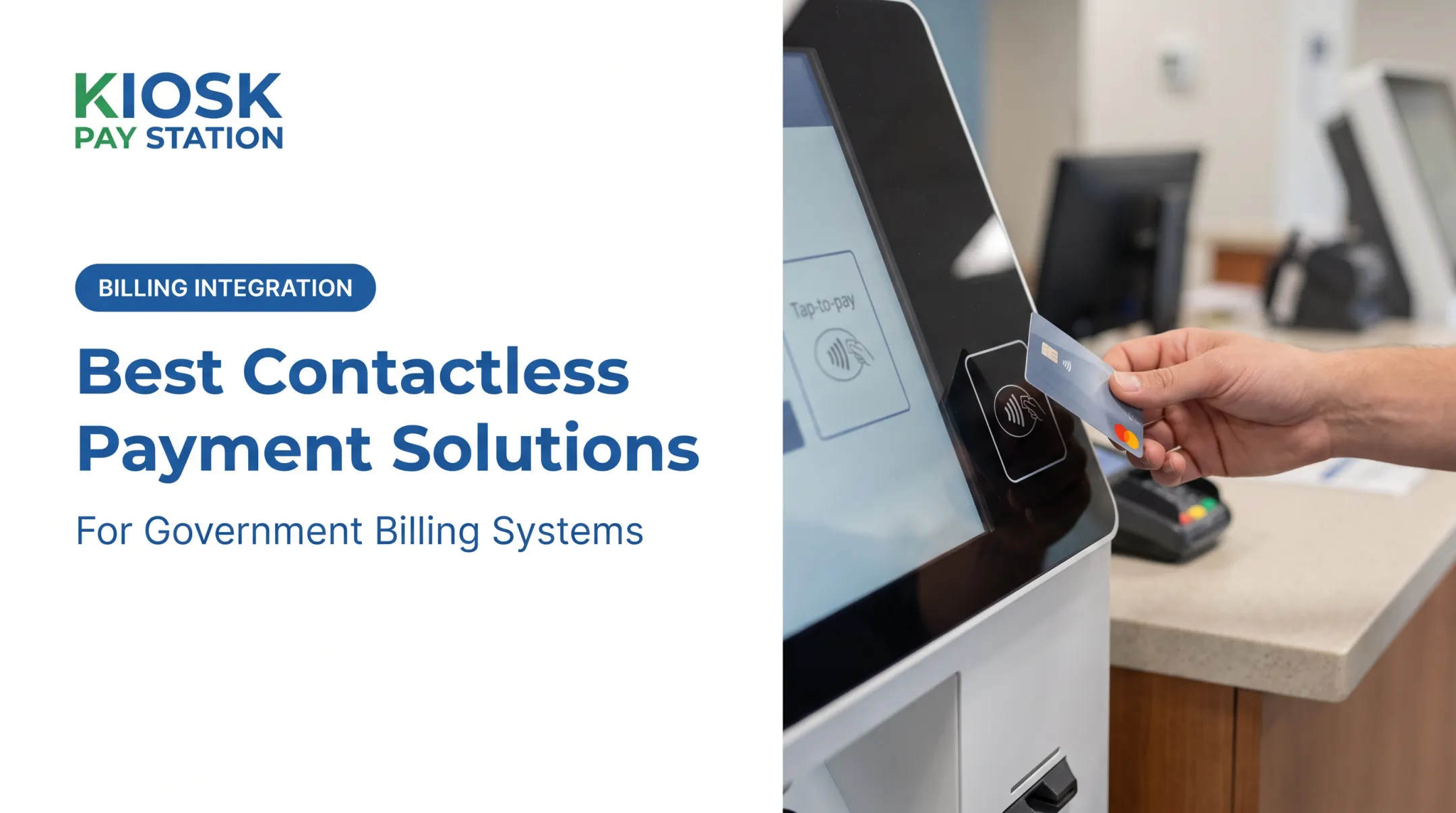
NFC-enabled taps through Apple Pay, Google Pay, and contactless cards have become the dominant way people pay in person. Retail counters and government payment centers alike are moving away from swipe-and-insert card readers toward one-tap transactions.
The growth trajectory is clear. Contactless card payment value climbed from $0.02 trillion in 2018 to $0.11 trillion in 2020, according to the Federal Reserve Payments Study.
That momentum has not slowed. Mobile-phone payment frequency has nearly tripled since 2018, and government payment centers that still require inserted cards or cash-only counters are increasingly the exception, not the norm.
Self-Service Payment Kiosks
Self-service kiosks let residents pay bills, fines, and utility charges using card, cash, check, or e-wallet without waiting for staff assistance. That's a meaningful shift for agencies that have historically staffed cashier windows during limited business hours.
Riverside County shows what that looks like in practice. Over a seven-day period, two self-service kiosks collected $3.01 million (more than 50% of total tax payments collected), while eight staffed cashier stations processed $2.4 million in the same window. That's a $601,000 gap: roughly 25% more dollar volume from just two machines than eight people.

Utilities are seeing similar results. Fort Wayne City Utilities runs kiosks accepting cash, checks, and debit/credit cards, with one location available 24/7. Springfield City Utilities follows the same model.
That availability matters for courts, tax collectors, and utility providers that need constant access without adding headcount. KIOSK PAY STATION supports this use case through billing-system integration, monitoring, and support, with real-time, file-based, or non-validated options that connect to existing billing systems.
Real-Time Payment Processing
Instant settlement rails move funds in seconds instead of days, giving finance teams real-time visibility into cash flow instead of waiting on batch ACH cycles.
Adoption is accelerating fast:
- FedNow surpassed 1,400 participating institutions by July 2025, up from 900 a year earlier (Federal Reserve Financial Services)
- FedNow quarterly volume hit 2.1 million payments, up 62%, with average daily transaction value up more than 400%
- The RTP network processed 343 million payments worth $246 billion in 2024, up 38% and 94% respectively

Same-day reconciliation is becoming an expectation rather than a bonus feature, particularly for payroll, refunds, and supplier payments that used to sit in ACH holding patterns for days.
AI-Driven Fraud Detection
Machine learning models now flag anomalous transaction patterns before settlement completes, rather than after a chargeback lands. This shift matters because traditional rule-based fraud detection tends to over-flag legitimate transactions, frustrating customers with false declines.
Mastercard reported in May 2024 that its generative-AI fraud tools were doubling the detection rate of compromised cards. On the government side, U.S. Treasury fraud-detection tools (including machine-learning AI) produced over $4 billion in fraud prevention and recovery in fiscal year 2024, according to a Federal Reserve Governor's 2024 speech.
For agencies handling constituent payments, this means fewer legitimate transactions getting stuck in review while fraud attempts get caught earlier.
Biometric Authentication
Fingerprint, facial, and voice recognition are steadily replacing PINs and passwords as the way people verify payments. Growing comfort with unlocking a smartphone via face scan translates directly into comfort authenticating a payment the same way.

Visa's Payment Passkey product replaces passwords and SMS one-time codes with a biometric passkey stored on the device, so no typed credentials are required.
For self-service kiosks, that points toward touchless authentication paired with accessible design. Large touchscreens, voice instructions, and light guidance already used in ADA-accessible kiosk deployments preview where authentication is headed next.
What's Driving These Digital Payment Trends
A mix of technology maturity, constituent demand, and cost pressure is accelerating this shift. U.S. noncash payments hit 236.6 billion transactions in 2024, more than tripling since 2000, according to the Federal Reserve's 2025 triennial payments study.
Three forces are pushing this forward:
- Technology maturity: cloud infrastructure, APIs, and AI now make integration faster and cheaper than it was five years ago
- Constituent demand: people expect to pay bills whenever they want, not just between 9 a.m. and 5 p.m.
- Cost pressure: agencies need to reduce manual cashier and reconciliation labor without cutting service

How These Trends Are Impacting Businesses and Public Agencies
These shifts change daily operations as much as they change the customer experience, and the outcomes are measurable.
Operational Impact
Self-service and integrated payment systems reduce front-counter workload and automate daily reconciliation. Integration options like real-time, file-based, and non-validated synchronization let payment data flow directly into existing billing systems instead of requiring manual entry. That frees staff for higher-value work instead of counting drawers:
- Collections
- Customer service escalations
- Account research
Financial Impact
Combining self-service collection with real-time settlement rails delivers faster fund availability and lower processing costs. Custom transaction data (department codes, account numbers, property IDs) travels with every payment, giving finance teams cleaner, export-ready records without extra reconciliation labor.
Security and Compliance Impact
As transaction volume grows, so does regulatory scrutiny. PCI DSS v4.0.1 was published in June 2024, with its effective date confirmed for March 31, 2025. Agencies need PCI DSS compliance, EMV-certified card acceptance, and encrypted processing as baseline requirements, not optional upgrades.
Future Signals to Watch
Track these developments over the next one to three years:
- Account-to-account (A2A) payments: Instant A2A transfers are reducing dependency on card networks. A 2025 Federal Reserve note identifies FedNow and RTP as the two major U.S. instant-payment systems behind this shift.
- Embedded finance expansion: Government and utility portals are adding native bill-pay options so constituents can pay without leaving the agency site.
- ADA-accessible, multilingual kiosks: Wider rollout of self-service terminals with large touchscreens, voice guidance, and multilingual interfaces in government and utility settings.
Conclusion
Contactless payments, self-service kiosks, real-time rails, and AI-secured fraud detection are reshaping how agencies and utilities collect money. The Riverside County numbers alone make the case: two kiosks outcollected eight staffed stations by 25% in total dollars.
Organizations that adopt these technologies early improve efficiency and constituent satisfaction. Those that wait face rising operational costs and growing pressure from residents who expect to pay a bill on their own schedule, not the agency's.
Frequently Asked Questions
What are payment technologies?
Payment technologies are the hardware, software, and networks that initiate, authorize, and secure electronic transactions. This includes card readers, kiosks, payment gateways, and the settlement rails that move money between accounts.
What are the latest payment technologies?
The current wave includes contactless/NFC payments, self-service kiosks, real-time payment rails like FedNow and RTP, AI-driven fraud detection, and biometric authentication. Each addresses a different friction point in traditional payment collection.
What are the types of electronic payment systems?
Common types include credit and debit cards, bank transfers, digital wallets, peer-to-peer (P2P) transfers, and self-service kiosks. Government agencies typically rely on a mix of several to serve different constituent preferences.
What is an example of a payment service provider (PSP)?
Stripe, PayPal, and Adyen are commonly cited PSPs. They supply the infrastructure to accept payments, manage billing, and move money without building processors from scratch.
How is digital payment technology used in government and public agencies?
Agencies use self-service kiosks and online portals for tax bills, utility payments, court fines, and fees. These systems let residents pay outside business hours while reducing counter staffing needs.
What security standards should businesses look for in payment technology?
Look for PCI-DSS compliance, EMV certification for card acceptance, and encrypted transaction processing. PCI DSS v4.0.1 requirements took effect in March 2025, so current compliance matters now.