But accepting credit and debit cards through an unattended kiosk isn't as simple as installing a card reader. Agencies handling public funds need EMV-certified hardware to avoid fraud liability and meet compliance standards, or they risk absorbing costs that should never land on their books.
This guide covers what EMV is, how it works, and why it matters specifically for public-sector self-service payment kiosks.
Key Takeaways
- EMV chip technology is the global standard for secure card-present transactions, replacing magnetic stripe swipes
- Proper EMV implementation shifts counterfeit-fraud liability away from the merchant or agency
- Government kiosks need both EMV certification and PCI-DSS compliance to safely accept payments
- NFC/contactless and EMV are different technologies; most modern terminals support both
What Is EMV Payment Processing?
EMV stands for Europay, Mastercard, and Visa, the three card networks that built the original chip-card specifications in the 1990s. The standard is now governed by EMVCo, whose members have expanded to include American Express, Discover, JCB, and UnionPay.
Unlike a magnetic stripe, which stores static account data that can be copied and reused, an EMV chip generates a unique transaction code every time it's used. Stolen chip data from one transaction can't be replayed to authorize a second one.
Three Types of EMV Transactions
- Chip-and-PIN — cardholder inserts the card and enters a PIN
- Chip-and-signature — cardholder inserts the card and signs
- Contactless/tap — cardholder taps a chip-enabled card or device near the reader
According to Digital Transactions' October 2025 report citing EMVCo data, EMV chip transactions now account for 93.51% of U.S. card-present transactions. Non-EMV acceptance is now the exception, not the norm.
Not every chip-equipped terminal is EMV compliant. A terminal or kiosk must be independently EMV-certified for the specific card networks it accepts, not just fitted with a chip reader.
How Does an EMV Transaction Work? (Step-by-Step)
When a resident inserts or taps a card at a kiosk, a sequence of cryptographic checks happens in seconds:
- Card insertion or tap — The cardholder presents their EMV chip card to a certified reader
- Chip authentication — The terminal reads encrypted chip data and runs checks to confirm the card hasn't been cloned or tampered with
- Cryptogram generation — The chip creates a one-time transaction code (an Authorization Request Cryptogram) that's unique to that specific payment
- Issuer review — The card issuer evaluates the cryptogram and the transaction's risk profile
- Approval and completion — The issuer returns an approval or decline; if approved, funds transfer and the transaction completes

This process is why stolen EMV chip data is nearly useless to fraudsters. A swiped magnetic stripe hands over the same static number every time, so a copied card can be reused indefinitely.
A cloned chip transaction can't reproduce a valid cryptogram for a future purchase. That difference is why chip technology cut counterfeit card fraud so sharply after U.S. adoption.
EMV Technology in Self-Service Payment Kiosks for Government Agencies
Unattended kiosks carry higher security stakes than a staffed counter. There's no cashier to catch a suspicious card or step in if something looks off; the terminal has to handle authentication entirely on its own, 24/7.
That's why EMV certification on a kiosk isn't optional. It has to be paired with:
- PCI-DSS compliant processing to protect stored and transmitted payment data
- Encrypted transmission between the kiosk and the payment processor
- Ongoing monitoring to catch tampering or hardware issues before they become liabilities
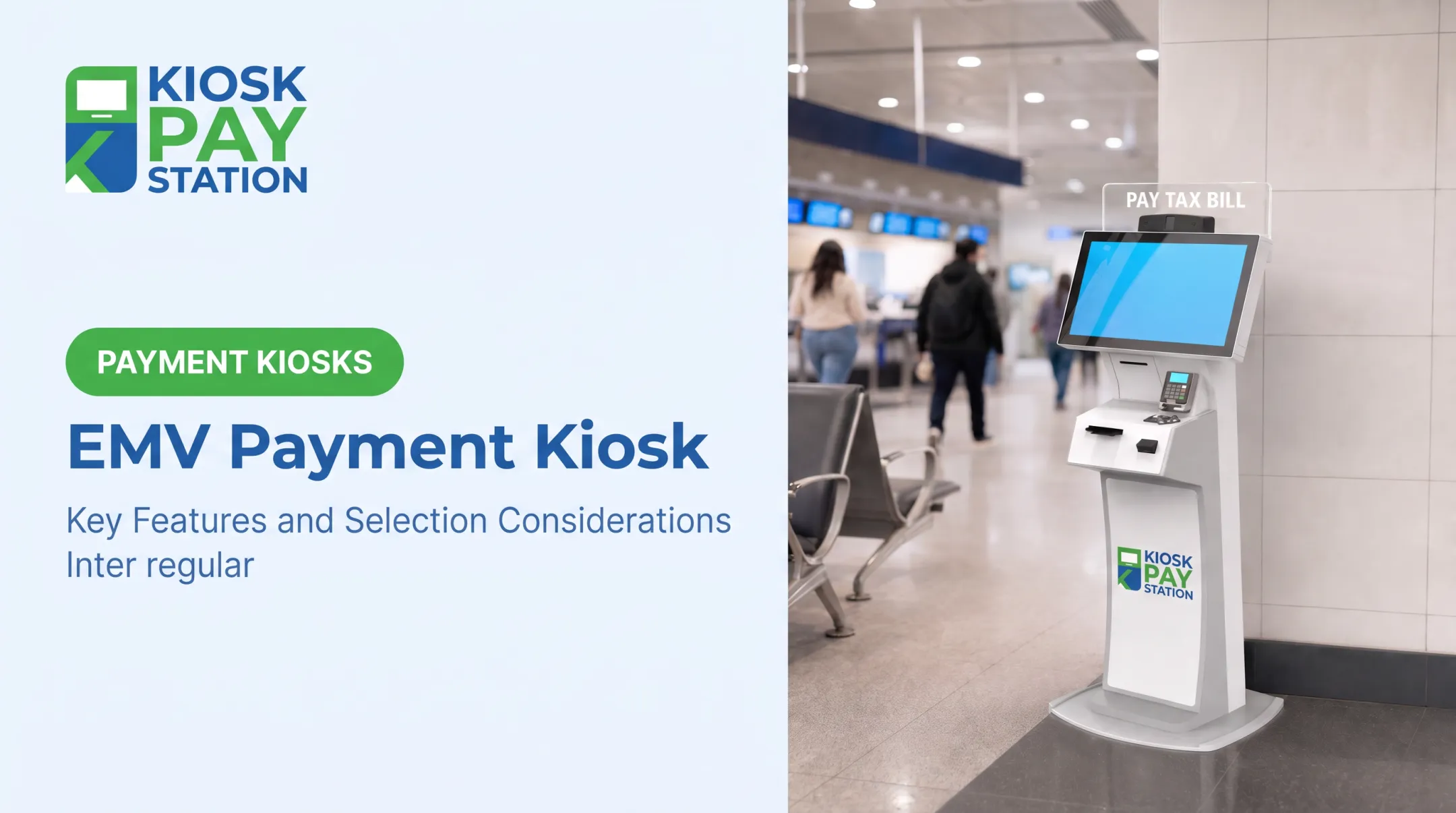
KIOSK PAY STATION supports government payment environments built on that same stack: EMV-certified card acceptance, PCI-DSS compliant processing, and encrypted transactions, with integration and monitoring for existing institutional setups. Agencies can take credit, debit, cash, check, and e-wallet payments without the fraud exposure that poorly secured unattended hardware creates.
A Real-World Example: Riverside County
Riverside County deployed two self-service kiosks that collected $3,001,000 in payments over a seven-day period — more than 50% of the taxes collected during that window. Compare that to eight staffed cashier stations, which processed $2,400,000 over the same seven days.

Two unattended kiosks outperformed eight staffed counters. For tax and utility collection windows, EMV-certified self-service capacity can move more volume than a full cashier line—without extending staffed hours.
Alongside EMV, agencies usually require:
- ADA-accessible design with large touchscreens and voice/light guidance
- Multilingual interfaces for diverse constituent populations
- Ongoing maintenance and component support so terminals stay certified and online
Why EMV Matters for Fraud Liability and Compliance
In October 2015, the major card networks implemented what's known as the liability shift. If a merchant or agency hasn't adopted EMV-capable processing and a counterfeit-card fraud transaction occurs, liability generally shifts to the merchant or acquirer rather than staying with the card issuer.
Three points matter in practice:
- There's no federal law mandating EMV. This is a network rule, not a statute.
- The liability shift follows a "least secure party" principle: whichever party didn't invest in chip technology tends to absorb the fraud cost.
- Exact outcomes depend on card network, card type, and fraud category, so it's not an absolute guarantee in every scenario.
For agencies processing high transaction volumes through unattended kiosks, non-compliance creates real financial exposure. Pairing EMV with point-to-point encryption and PCI-DSS certification builds layered protection, so a single control failure does not leave the full fraud cost on the agency.

Choosing the Right EMV-Enabled Payment Kiosk for Your Agency
Picking a kiosk isn't just about the card reader. A few factors should drive the decision:
- Transaction volume — high-traffic tax offices need different throughput than a small utility department
- Configuration — standalone units, countertop models, or in-wall installations each fit different physical spaces
- Payment variety — accepting EMV chip, contactless, cash, and check in one machine serves constituents who don't all bank the same way
Integration Matters as Much as Hardware
Legacy back-office systems don't always play nicely with new payment technology. Look for kiosks that support:
- Real-time integration — payment data syncs instantly with treasury, court, or utility systems
- File-based integration — payment records exchange through scheduled file transfers
- Non-validated integration — a simpler data-synchronization path for less complex environments
KIOSK PAY STATION helps agencies connect EMV-enabled payment environments to treasury, court, and utility systems using real-time, file-based, or non-validated integration. Unlimited custom transaction data fields—department codes, account numbers, property IDs—keep reconciliation from becoming a manual cleanup job.
Frequently Asked Questions
How does an EMV transaction work?
The chip card is inserted or tapped, the terminal authenticates the chip and generates a one-time transaction code, and the issuer approves or declines based on that code. The whole process completes in seconds.
What does EMV mean in payments?
EMV stands for Europay, Mastercard, and Visa — the networks that created the original chip-card standard. It refers to the secure, chip-based technology now used for most card-present transactions.
Is EMV the same as NFC?
No. EMV is the chip-based payment specification, while NFC is the wireless communication technology behind contactless/tap payments. Modern EMV-certified terminals typically support both contact and contactless methods.
Are businesses and agencies legally required to use EMV?
There's no federal mandate requiring EMV. However, the 2015 liability shift means agencies without EMV-capable terminals can be held financially responsible for certain counterfeit-fraud transactions.
Can self-service kiosks accept EMV chip card payments?
Yes. EMV-certified self-service kiosks accept chip and contactless payments without staff present. KIOSK PAY STATION supports EMV-compliant billing integration for government and utility bill-payment workflows.
Why do EMV transactions sometimes take longer than swiping?
The chip and terminal exchange encrypted authentication data before generating a transaction-specific code, which takes a few extra seconds compared to a swipe. Contactless/tap payments offer a faster alternative while keeping EMV-level security.