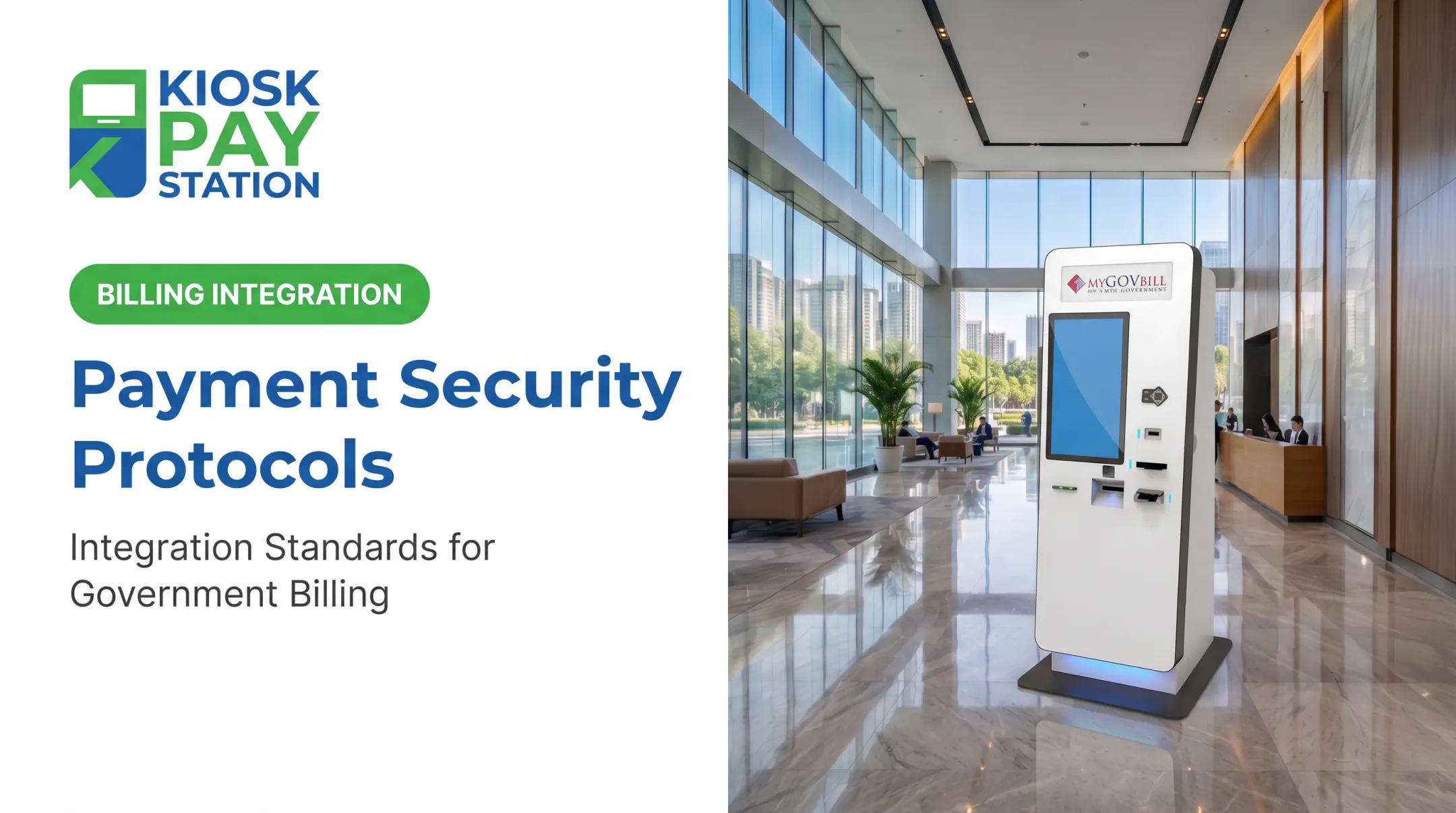
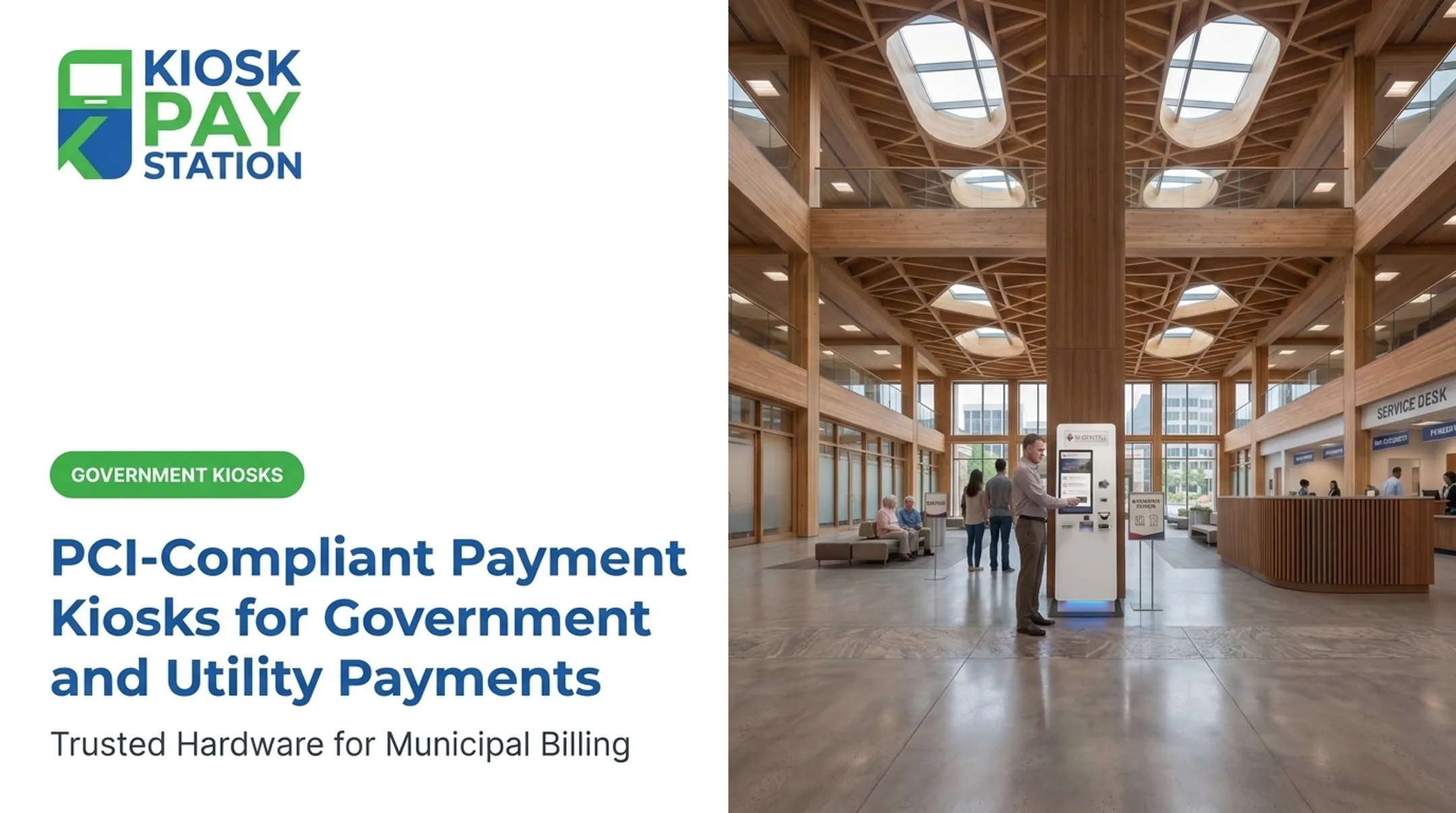
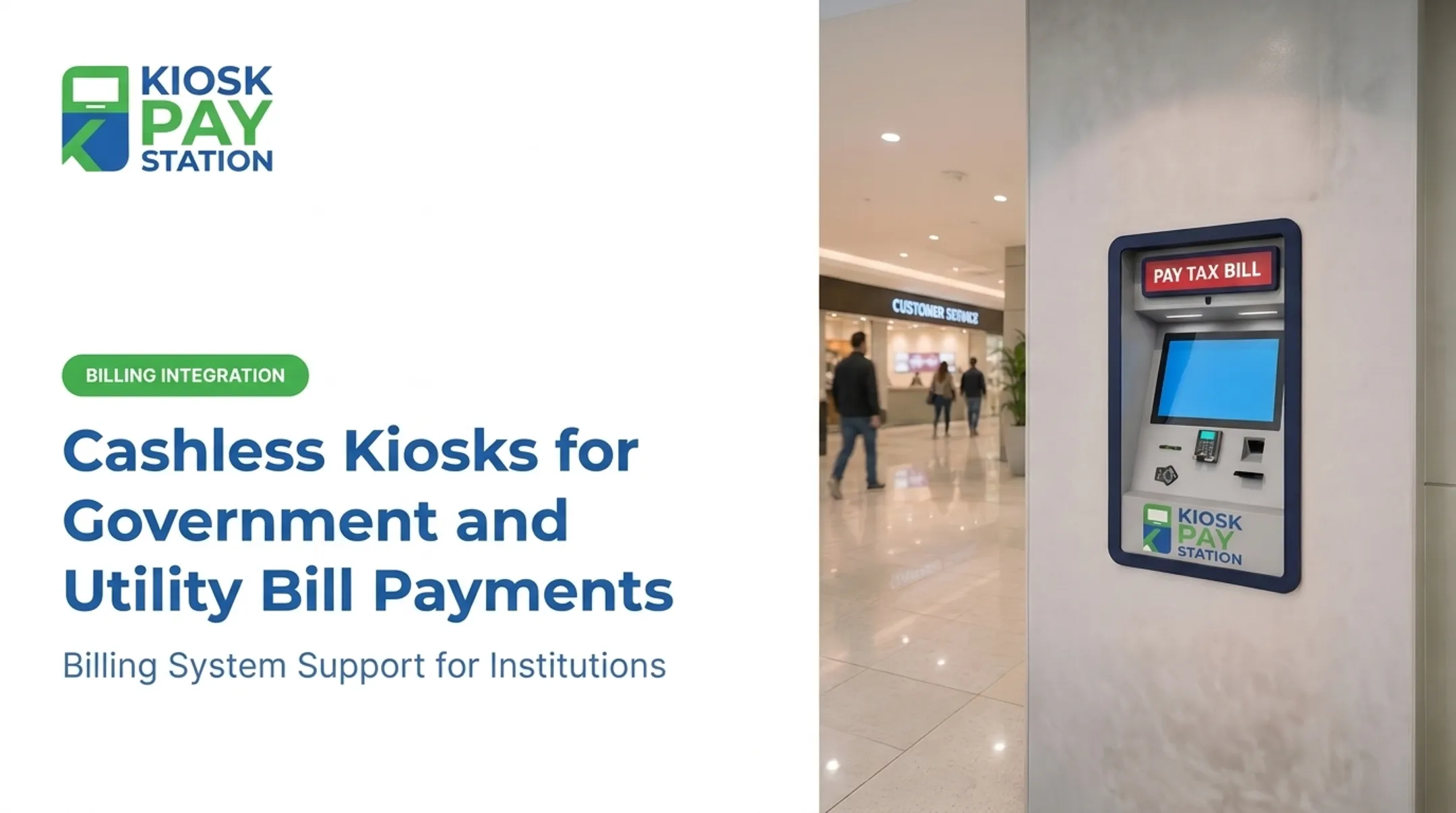
Many utility offices and city halls still struggle with long lines, limited business hours, and payment reconciliation that eats up staff time. This article focuses specifically on cash collection through self-service kiosks — the full path from a resident's payment to a receipt, an updated account, and a reconciled ledger entry.
We'll cover how the kiosk cash collection process actually works, the security and compliance controls agencies need, accessibility requirements, performance measurement, and how to evaluate a kiosk program before committing to one.
Key Takeaways
- Cash collection is a full workflow: account ID, validation, receipts, settlement, reconciliation, and exceptions.
- Support cash, check, card, and e-wallet—and keep a clear audit trail on every transaction.
- Automation cuts counter workload and errors; cash custody and reconciliation policies still matter.
- Align methods, integrations, accessibility, hours, and reporting with your agency’s controls.
What Cash Collection Means for Government and Utility Kiosks
In the public sector, cash collection means receiving a payment from a constituent or utility customer, confirming it is applied to the correct account, and documenting the chain from receipt to deposit. Physical custody, validation, and deposit all sit inside that definition.
Cash operates differently than electronic tender. Bills and coins require physical handling: storage, counting, and secure transport to a bank. Checks, credit cards, debit cards, e-wallets, and ACH move through validation and settlement instead, with no physical custody chain.
This is why a standard accounts receivable formula doesn't fully capture kiosk operations. Agencies need to separate:
- Historical cash actually received and deposited
- Operational kiosk totals, including accepted payments, refunds, voids, failed transactions, and settlement differences
Data Agencies Need to Capture
Every kiosk transaction should record specific fields to support downstream reconciliation:
- Account numbers, invoice numbers, or property IDs
- Department codes
- Payment amount and method
- Kiosk location and timestamp
- Confirmation number
KIOSK PAY STATION's platform supports unlimited custom data elements per transaction, including department codes, account numbers, property IDs, or any other field an agency defines. That detail feeds multiple workflows at once:
- Utility account updates
- Department reporting
- Daily reconciliation
- Audit preparation
- Financial planning
When account lookup and payment acceptance share clean data, speed follows. Kansas City's water utility reported that its self-service kiosks processed the average transaction in under one minute, based on internal usage data.

How the Cash Collection Process Works
The kiosk cash collection process runs from the moment a resident approaches the machine to the moment reconciled funds land in the agency's books.
Account Lookup and Transaction Data Capture
Customers need a fast way to find their account. Kiosks typically support lookup by:
- Invoice number
- Barcode or QR code (scanned directly off a bill or notice)
- Account number or name
- Property ID or custom identifier
Account validation at this stage reduces misapplied payments significantly. Agencies should decide which identifiers make sense per department — a tax collector might rely on parcel numbers, while a utility might use account numbers tied to service addresses.
Payment Acceptance and Cash Handling
Once the account is confirmed, the kiosk accepts cash, checks, credit or debit cards, or e-wallets. Fees, payment limits, and confirmation messages should display clearly before the customer commits.
For cash specifically, this includes bill acceptance, secure cash storage, and, on many deployed units, exact-change dispensing in bills and coins. A time-dated receipt should print automatically, and the system needs a defined procedure for transactions that are interrupted or left incomplete.
Settlement, Reconciliation, and Exceptions
Transaction data then moves to the agency's billing or accounting system through real-time, file-based, or other approved integration methods. This is where exception handling becomes critical:
- Overpayments and underpayments get flagged for review
- Duplicate transactions are caught before double-posting
- Declined cards or unreadable checks route to a manual queue
- Connectivity failures trigger a hold-and-retry process
- Unmatched transactions get investigated before end-of-day close
Worked example: A resident pays a $185 water bill at a kiosk using a debit card. The kiosk captures the account number, timestamp, and confirmation ID, then transmits the transaction to the utility's billing system in real time. At day's end, the finance team pulls the kiosk journal, matches it against the processor's settlement file and the bank deposit, and confirms all $185 posted to the correct account with no variance. Any mismatch (say, a $185 payment that shows in the processor file but not the billing system) becomes a same-day exception, not a month-end surprise.

Security, Compliance, and Operational Controls
Protecting payment data and public funds requires layered controls: encrypted processing, secure card acceptance, access restrictions, system logging, and regular reconciliation.
PCI DSS and EMV: What the Credentials Actually Mean
KIOSK PAY STATION states its kiosks are PCI-DSS compliant, PCI DSS Level 1 certified, and EMV certified. Here's what agencies should understand about those terms:
- PCI DSS is a baseline standard for protecting payment account data across any system that stores, processes, or transmits it, according to the PCI Security Standards Council.
- Level 1 validation requirements are set by individual payment brands, not by the vendor, so agencies should confirm in writing which validation path applies to their specific deployment.
- EMV certification verifies that the card reader and its software (the "kernel") passed conformance testing for chip and contactless transactions.
None of these credentials remove the agency's own compliance responsibility. Always request current certification evidence, including the exact hardware, firmware, and configuration deployed — not just a general claim.
Physical Cash Controls
Cash-accepting kiosks need the same rigor as a staffed cash drawer, including:
- Secured cash compartments with defined collection schedules
- Denomination counts and chain-of-custody documentation
- Dual-control procedures for cash pickup
- Deposit verification and variance investigation
- Separation of duties between collection, counting, and reconciliation

Specific procedures should follow the agency's own banking requirements and state or local regulations — there's no single universal standard here, so check with your state auditor's office or comparable authority.
Accessibility and Business Continuity
Under the ADA 2010 Standards, self-service collection machines fall under Section 707. Agencies should verify compliance directly rather than assuming any touchscreen device qualifies. Practical accessibility features include:
- Large touch screens
- Voice and light instructions
- Multilingual interfaces
- ADA-compliant placement and reach ranges
Uptime controls matter as much as access. Plan for:
- Remote monitoring of connectivity and power
- Preventive maintenance on printers and cash modules
- A clear escalation path when a unit goes offline
Benefits of Kiosk-Based Cash Collection
Kiosks reduce front-desk congestion by letting customers complete routine cash and bill payments without waiting for a staffed window. That frees staff for more complex service requests: disputes, account corrections, or in-depth customer service.
Customer-experience gains include:
- Faster cash and card transactions with no counter wait
- Extended or 24/7 availability, set by the agency
- Cash, check, card, and e-wallet methods in one device
- Multilingual, accessible interfaces
On the operations side, automated receipts and standardized data capture support cleaner books. Traceable transactions and consistent exception documentation make audit review far less painful than reconstructing a manual cash log.
Riverside County: A Verified Example
Riverside County deployed two self-service kiosks that collected $3.01 million over a seven-day period, outperforming eight staffed cashier stations that processed $2.4 million in the same window. The two kiosks accounted for more than half of total payments collected during that period.

This is a strong illustration of throughput, but agencies evaluating a similar program should still validate their own baseline. Case results from one county don't automatically transfer to a different department's payment mix or customer base.
How to Plan and Evaluate a Payment Kiosk Program
Before selecting a kiosk solution, build an evaluation checklist covering:
- Payment volume and transaction types
- Cash, check, card, and e-wallet needs
- Account lookup methods required
- Data fields and integration requirements
- Receipt formats and operating hours
- Accessibility and location security
- Staffing, maintenance, and total cost of ownership
Where KIOSK PAY STATION Fits
KIOSK PAY STATION provides billing-system integration, monitoring, and support for government and utility payment programs. Agencies can connect custom transaction data elements, multilingual interfaces, and ADA-oriented workflows through real-time, file-based, or non-validated integration, depending on what the billing system supports. Ongoing monitoring and maintenance help keep reconciliation, uptime, and exception handling aligned with day-to-day operations.
A Phased Rollout
- Document the current counter-based workflow before changing anything
- Select a pilot location or department with manageable transaction volume
- Define reconciliation and cash custody procedures up front
- Train staff on exception handling and escalation
- Test exception scenarios deliberately — declined cards, unreadable checks, connectivity drops
- Monitor agreed performance indicators and collect customer feedback
- Refine before expanding to additional locations
What to Measure
Track these indicators against your own pre-launch baseline:
- Transaction volume by payment method
- Reconciliation time and exception frequency
- Staff processing time per payment
- Uptime and payment completion rate
- Maintenance incidents
Compare results in your environment. Do not rely on vendor-reported percentages that were never measured on your systems.
Frequently Asked Questions
What is cash collection?
Cash collection is the process of receiving, recording, applying, settling, and reconciling customer payments. For government and utility kiosks, this applies to cash, checks, cards, and e-wallets alike.
How do you calculate cash collection?
Total the successfully accepted payments for the reporting period, then reconcile against refunds, voids, settlements, and deposit records. This differs from the standard accounts receivable formula because kiosk reconciliation must also account for failed and interrupted transactions.
What is the cash collection process?
The cash collection process runs from kiosk to deposited funds: account lookup, payment acceptance, receipt issuance, transmission to the billing system, settlement, reconciliation, exception handling, and reporting.