Kiosk best practices for self-service bill payment combine five things: an intuitive user experience, secure payment processing, accessible design, reliable day-to-day operations, and accurate back-office reporting. Miss any one of these, and adoption suffers.
This guide is built for U.S. government agencies, utilities, courts, and public-service organizations evaluating or refining a self-service payment kiosk program. The goal throughout: make payment easier for the customer while cutting the avoidable workload that lands on staff.
Key Takeaways
- Design for the full journey: account lookup, payment selection, confirmation, and receipt.
- Support the payment methods customers actually use, with PCI-DSS-aligned hardware and procedures.
- Build accessibility, multilingual support, privacy, and maintenance into the initial design.
- Track completion, abandonment, errors, uptime, and reconciliation exceptions after launch.
Choose the Right Kiosk Location and Hardware
Placement determines whether people notice the kiosk at all. A unit tucked in a back corner won't reduce counter traffic no matter how well it's built.
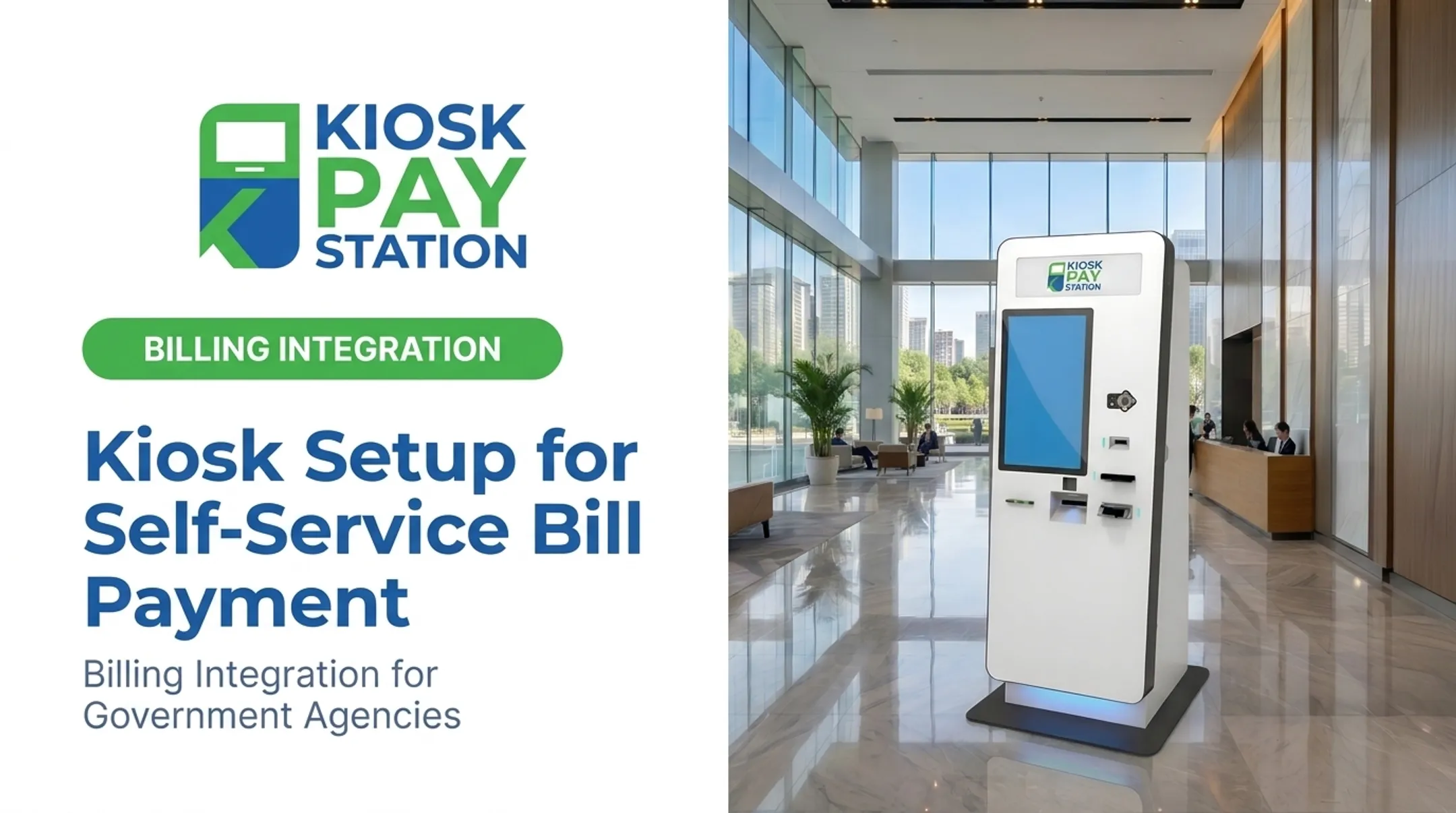
Put kiosks in visible, well-lit spots near the relevant payment service — a lobby, a customer-service window, a city hall entrance. Avoid blocking walkways, and give payers enough space that entering an account number or swiping a card doesn't feel like a public event.
Yuma, Arizona placed a self-service utility-payment kiosk outside City Hall that runs 24/7/365 with video monitoring, and the city credits it with cutting wait times. That's the pattern worth copying: visible, always-on, and monitored.
Comparing Kiosk Configurations
Once placement is set, match the form factor to your space, traffic volume, and cash-handling needs.
| Configuration | Best For | Cash Handling | Space Needs |
|---|---|---|---|
| Standalone | High-traffic lobbies, public spaces | Yes, including exact-change dispensing | Floor space required |
| Countertop | Existing service counters | Optional, usually cashless | Minimal |
| In-Wall | Permanent or exterior installations, 24/7 vestibules | Cashless or cash-and-change | Recessed, no floor footprint |
Hardware That Holds Up Under Daily Use
Public-facing payment hardware takes a beating. Plan for:
- A responsive touchscreen (Pay Station Pro uses a 21.5-inch display)
- An EMV card reader supporting tap, dip, and swipe
- A barcode or check scanner where account lookup or check payments apply
- A cash acceptor, if your customer base needs it
- A timestamped receipt printer
- A secure steel enclosure with tamper resistance, reliable network connectivity, and accessible physical controls
Buy for durability and serviceability, not just the lowest sticker price. A kiosk that's down for three days because a part isn't stocked locally costs more in lost payments and staff frustration than the savings on day one.
Design the Payment Journey Around the User
A good kiosk workflow feels almost invisible. The payer picks a language, finds their account, reviews what they owe, chooses how to pay, confirms, and walks away with a receipt.

- Select a language – keep this available throughout, not just on the welcome screen
- Identify the account – by invoice number, account number, property ID, barcode, QR code, or name
- Review balances or charges – show exactly what's owed before asking for money
- Select amount and payment method – allow partial payments when policy permits, and surface every accepted method up front
- Confirm details – account, amount, fees, payment method
- Submit and receive confirmation – with a receipt or on-screen confirmation
That second step—getting the right account on screen—is where most failed payments start. Build it carefully.
Account Lookup Without the Guesswork
Wrong-account payments create reconciliation headaches. Coppell, Texas addresses this by letting customers scan a barcode, enter an account number, or search by address and last name — multiple paths that all land on a verified match. Kiosk Pay Station's approach works the same way: scanning a bill's QR code or barcode, or entering a name or account number, pulls up the correct account in seconds.
Handling Errors Without Calling Staff Over
Design for the moments things go wrong:
- Invalid account info – prompt for another lookup method instead of a dead end
- Declined cards – suggest a second payment method
- Duplicate submissions – detect and block before processing twice
- Network interruptions – hold the transaction state and retry automatically
- Unreadable checks – offer rescanning or an alternate payment path
Before submission, show a review screen with the account, amount, fees, and payment method.
After submission, the receipt should include a transaction reference, date, time, amount, and support contact. Leave sensitive account details off the printout so a stranger nearby cannot glance at them.
Build Security, Accessibility, and Trust Into Every Transaction
Payment security and accessibility belong in the design from day one. Retrofitting either one later is expensive and disruptive.
Payment Security Controls
At minimum, a bill-payment kiosk should support:
- PCI-DSS-aligned payment handling
- EMV-certified card acceptance where applicable
- Encryption of payment data in transit and at rest
- Restricted operating-system access and locked-down device configuration
- Session timeouts that clear data if a payer walks away mid-transaction
- Timely security patching
PCI DSS v4.0.1 became the only active version after v4.0 retired at the end of 2024. Kiosk Pay Station is PCI-DSS compliant and EMV certified, with encrypted processing built into the transaction flow.
Privacy Is Different From Security
Security protects the payment data itself. Privacy protects the person standing at the kiosk. Practical steps include:
- Position screens so account numbers stay out of view for the next person in line
- Angle keypads to reduce shoulder surfing
- Avoid unnecessary local storage of sensitive information
Accessibility Isn't Optional
Federal obligations vary by machine type and agency, but the direction is consistent. The 2010 ADA Standards require ATMs and certain self-service transaction machines to meet clear floor space, operable-parts, and privacy requirements.
Section508.gov also classifies information kiosks as covered federal ICT hardware for agencies subject to Section 508.
Design for:
- Reachable controls and appropriately sized touch targets
- Readable text with strong contrast
- Audio or voice guidance
- Compatibility with tactile or alternative input where feasible
Kiosk Pay Station supports ADA-accessible deployments with multilingual interfaces and voice-and-light guidance. Those capabilities matter more as accessibility rulemaking around self-service transaction machines continues to develop.
Multilingual Access and Trust Signals
If a meaningful share of your community doesn't primarily speak English, keep language selection available at every step, not just the welcome screen. California's Dymally-Alatorre Bilingual Services Act requires language access for agencies serving substantial non-English-speaking populations, defined as 5 percent or more of the people served. Other states set their own thresholds, so confirm what applies before you launch.
Trust also comes from small operational signals:
- Transparent fee disclosure before payment
- Recognizable agency branding on screen and enclosure
- A visible path to reach a person when something goes wrong
- A posted privacy notice at the kiosk
Plan the Operational and Technical Foundation
The kiosk is only half the system. What happens behind it (validation, posting, reconciliation) determines whether the front-end experience holds up.
Integration Choices Affect Everything Downstream
| Integration Type | Account Validation | Reconciliation Timing | Complexity |
|---|---|---|---|
| Real-time | Validates instantly against live system | Same-day, automated | Higher upfront setup |
| File-based | Validates on batch upload | Delayed, scheduled | Moderate |
| Non-validated | No live check | Manual review needed | Lowest to implement |
Real-time integration syncs payment data with existing accounting systems as transactions happen, cutting manual entry and giving finance teams cleaner records. Kiosk Pay Station supports all three models, letting agencies match integration depth to their existing systems rather than rebuilding around the kiosk.
Custom Data Fields Support Real Workflows
Agencies rarely process a generic "bill." They track department codes, parcel or property IDs, case numbers, and utility account details. Kiosk Pay Station's transactions can carry unlimited custom data elements, so a court fee payment and a utility payment can each capture exactly the fields that department's reporting needs.
Assign Ownership Before Launch
Decide who owns each of these before go-live, not after the first dispute:
- Payment settlement and cash collection
- Receipt paper and consumable restocking
- Network support and software changes
- Accessibility review and customer assistance
- Disputed-transaction escalation
A deployment checklist should also cover:
- Payment-method configuration and fee rules
- Receipt content and connectivity testing
- Security review and staff training
- Launch-day support coverage
Get integration depth, data fields, and ownership clear before go-live so validation, posting, and reconciliation keep up with every payment the kiosk takes.
Maintain, Monitor, and Improve Performance
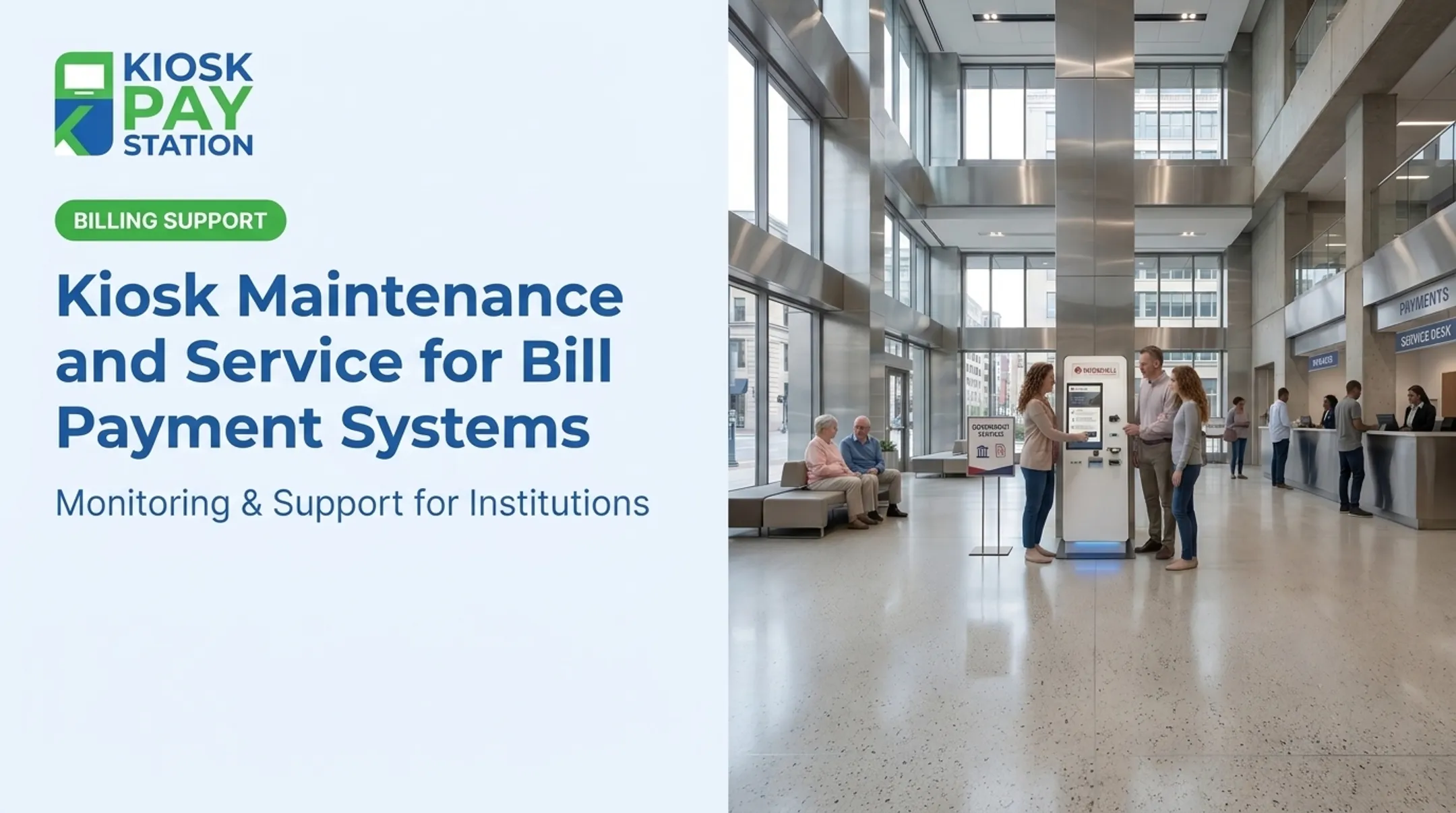
A kiosk that works on launch day needs upkeep to keep working a year later. Skip maintenance, and you'll eventually replace the counter line you just eliminated with a kiosk that's out of paper.
Build a Preventive Maintenance Routine
- Daily: wipe touch surfaces, check receipt paper, glance for visible damage
- Weekly: inspect card readers and scanners, test connectivity
- Monthly: review cash or check module capacity, audit for tampering
Adjust frequency based on transaction volume and location. A courthouse kiosk processing thousands of transactions a month needs more frequent checks than a low-volume utility office.
Monitor Remotely, Don't Wait for Complaints
Set up remote alerts so issues surface before customers report them. Cover at least:
- Kiosk availability and application errors
- Network loss and payment-device failures
- Printer status and cash capacity
Kiosk Pay Station pairs this model with five-year onsite maintenance and component replacement, plus customizable alerts for low paper or cash replenishment.
Metrics That Actually Tell You Something
Track:
- Successful payment completion and abandonment by screen
- Failed or declined payments
- Average task time and uptime
- Support interventions and reconciliation exceptions
- Adoption compared with staffed channels
Tracked results show the payoff. A courthouse case study documented more than 2,100 kiosk transactions totaling nearly $240,000 in one month, with shorter payment-window queues and staff moved to other work.
Riverside County saw similar gains with two Kiosk Pay Station units: $3.01 million collected in a seven-day period, versus $2.4 million processed by eight staffed cashier stations in the same week. More than half the total volume moved through just two machines.

Frequently Asked Questions
What are some creative ideas for kiosks?
Multilingual payment access, QR or barcode account lookup, receipt reprinting, and accessible audio guidance all add real value. Avoid adding features that compromise security or privacy, like storing unnecessary customer data for convenience.
What should a self-service bill payment kiosk be able to do?
It should handle account lookup, balance review, multiple payment methods, confirmation, and receipts. It also needs accessibility support, language selection, error recovery, and secure transaction processing.
How do you make a payment kiosk easy to use?
Use plain language, large clear actions, and one decision per screen. Show progress during processing, confirm details before submission, and test the flow with real customers, not just staff.
Are payment kiosks secure?
They can be, when built around PCI-DSS-aligned controls, EMV acceptance, encryption, session timeouts, and secure device management. Privacy-conscious placement and ongoing monitoring matter just as much as the underlying technology.
What payment methods should a bill-payment kiosk accept?
The right mix reflects customer demand and operations: commonly cash, checks, credit and debit cards, and e-wallets. Each method brings its own fee, settlement, and reconciliation considerations.
How can an organization measure whether a payment kiosk is working?
Look at completion and abandonment rates, failed transactions, uptime, and reconciliation exceptions. Compare workload and cost against the staffed process it's replacing, and factor in customer feedback.